
How 4 startups packaged and priced their product
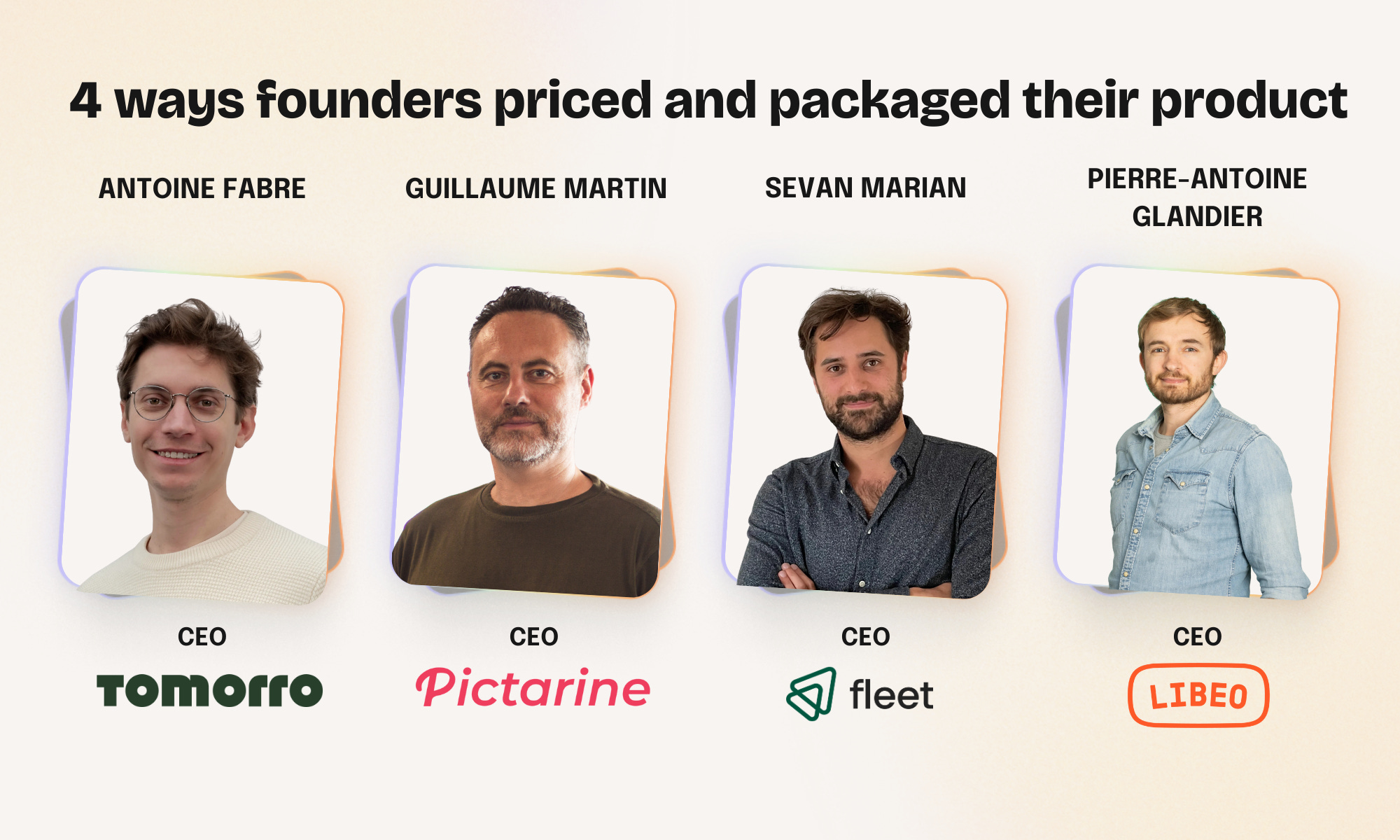
4 ways to package and price a product with Tomorro, Fleet, Pictarine and Libeo.

Hey, I’m Timothe, cofounder of Stellar & based in Paris.
I’ve spent the past years helping 500+ startups in Europe build better product orgs and strategies. Now I’m sharing what I’ve learned (and keep learning) in How They Build. For more: My Youtube Channel (🇫🇷) | My Podcast (🇫🇷) | Follow me on Linkedin.
If you’re not a subscriber, here’s what you’ve been missing:
In this special episode, I analyzed 4 concrete stories from startup CEOs who all faced the same question at a critical moment: how do you package and price a new product when usage, value, and costs are still evolving?
Across Tomorro, Fleet, Pictarine, and Libeo, the contexts are very different: AI-powered contract management, hardware leasing with software, consumer photo products, and B2B finance tooling. Yet the tension is the same everywhere. New features unlock massive value, but they also introduce new cost structures, new pricing risks, and new questions about fairness for existing customers.
Some of these teams priced from cost to protect margins. Others bundled everything to sell a vision first. Others had to regain control of pricing after years of not owning it. And some deliberately slowed down price increases despite shipping a lot more value.
What makes these stories interesting comes from the trade-offs, the intuition behind key decisions, and the moments when pricing becomes a strategic product decision rather than a simple spreadsheet exercise.
I broke down these 4 cases to extract clear, actionable lessons on packaging and pricing a new product, especially in environments shaped by AI, usage-based costs, and fast product expansion.
Disclaimer: The organizational choices and technical solutions shared in this newsletter aren’t meant to be copied and pasted as-is. Always keep your company’s context in mind before adopting something that works elsewhere! 😊Price from cost before pricing for value
When Tomorro introduced AI-powered features into its contract product, the first pricing decision centered on survival rather than perceived value. Antoine Fabre explains that their initial approach was deliberately cost-driven, especially because usage could explode quickly with AI.
They started by defining a concrete unit of reference: the contract. For each contract, they estimated how many summaries, questions, reformulations, and negotiation recommendations would be generated. From there, they calculated how much each action cost them through OpenAI. Only then did pricing come into the picture.
The goal focused on creating a safety net, with revenue optimization as a secondary priority. AI usage can scale unpredictably, and Antoine wanted to avoid a situation where prices stay flat while costs skyrocket. To protect themselves, they applied a very conservative multiplier.
“We were very arbitrary. We multiplied our costs by 5 to make sure we were safe”
– Antoine Fabre
What’s interesting is what this approach does not include. It does not account for customer value, time saved, or business impact. And that’s intentional. At this stage, pricing was treated like insurance. Some customers would cost more than others, but the system would hold.
This approach is especially relevant for teams launching AI features with variable usage. Before experimenting with value-based pricing, you need a floor that guarantees margin protection. Otherwise, you risk learning about your unit economics the hard way.
Raise prices only when value meaningfully shifts
Tomorro increased prices when the product reached major value milestones, linking pricing changes to meaningful shifts in the value delivered.
When the team launched a new negotiation feature, they decided to repackage and significantly increase prices. Prices doubled.
It was driven by a strong conviction about where value actually sits in the contract lifecycle. Antoine explains that generating a contract takes minutes, but negotiating it can take weeks. By accelerating negotiation, the product was accelerating revenue recognition, marketing cycles, and sales velocity.
“The value we launched is at least equivalent to everything we had built before” – Antoine Fabre
This is a powerful lesson. Pricing was tied to where the product attacked the biggest bottleneck. When that bottleneck moved, pricing moved with it.
For product leaders, this reframes pricing discussions. The focus shifts from asking whether more features were shipped to assessing whether the product unlocked a new order of magnitude of value. When that happens, repackaging becomes both legitimate and necessary.
Bundle first to sell a vision, unbundle later
Fleet took the opposite approach early on. When they launched their SaaS alongside hardware leasing, there was no separate pricing, no plans, and no options. Everything was bundled into one all-in-one subscription.
The logic was simple. The product was not mature enough to sell on its own. An inventory or device management system alone offered limited justification for standalone pricing. Integrated with leasing, it became part of a broader value proposition.
Sevan Marian explains that early customers bought into a vision while the product was still evolving. And because Fleet was already positioned as more expensive than pure leasing players, the SaaS could be absorbed without changing prices.
Over time, as the product matured, things changed. Advanced features like Mobile Device Management, security, and compliance became real value drivers. That’s when Fleet started unbundling. These features became paid add-ons, closer to a marketplace model than traditional SaaS plans.
The key insight is sequencing. Bundle to reduce friction and sell the future. Unbundle once value is explicit, differentiated, and understandable on its own.
Take control of pricing to unlock product strategy
For Pictarine, the pricing challenge centered on determining who held control over pricing.
For years, retail partners set the prices. The approach worked well for basic photo printing, then became increasingly strained as Pictarine introduced new features such as licensed templates and AI-powered image processing. These features introduced additional costs and investments while prices remained fixed.
The turning point came when Pictarine took control of payments inside the app. This reduced no-shows through prepayment, improved margins, and unlocked something even more important: pricing freedom.
“We suddenly had a super toy in our hands. We could do bundles, pricing tests, real e-commerce” – Guillaume Martin
Owning pricing allowed them to reflect product differentiation, fund innovation, and align incentives with partners. Higher prices meant higher commissions. Everyone won.
This case highlights a blind spot in many product strategies. If you don’t control pricing, you don’t fully control your product. Packaging, bundling, and monetization experiments all depend on that leverage.
Let users define the ‘right’ price, then test it
At Libeo, pricing was approached as a research problem before being a commercial one.
Pierre-Antoine Glandier describes a structured process built on open-ended user questionnaires. They explored what users perceived as fair, which alternatives they would consider, and how sensitive they were to price changes, instead of asking them to choose between predefined price options.
This qualitative input was then combined with data analysis to converge on a price. But Pierre-Antoine is clear: there is no perfect answer. The real test only happens in the market.
Since then, Libeo has added significant product value while keeping prices stable, reflecting a context where customers are more price-sensitive and long-term retention carries greater importance.
Now, the question is whether to introduce a higher-tier product or adjust prices to better reflect value, without breaking trust.
The lesson here is balance. User input helps frame pricing. Market feedback validates it. And timing matters as much as math.
The mistake: letting price lag behind delivered value for too long
Across these stories, one recurring risk appears: underpricing for too long after shipping meaningful value.
Both Tomorro and Libeo highlight moments where prices stayed flat while the product changed dramatically. This approach can feel customer-friendly while creating long-term tension. Teams hesitate to reprice later. Customers anchor on old prices. And revenue no longer reflects product reality.
The challenge is not knowing when value has increased. Teams usually feel it. The challenge is acting on it with confidence and clarity.
The takeaway focuses on treating pricing updates as part of product delivery. When value shifts, packaging and pricing evolve within the same narrative rather than months later.

Cost-based pricing often provides the safest way to launch AI-powered features when usage remains unpredictable, while maintaining a sustainable model for customers and the business.
The right moment to increase prices comes with a clear shift in where the product creates the most value, rather than with incremental feature releases.
Bundling early can help sell a vision before the product is mature enough to stand alone.
You don’t really own your product strategy if you don’t own pricing and payment.
User-driven pricing research is powerful, but market feedback is the only real validation.
Letting price lag too far behind value creates future friction that is harder to fix later.
Packaging and pricing function as product decisions that shape how value is delivered and captured, alongside their impact on revenue.
My video (in french 🇫🇷) about packaging and pricing
Dive deeper into this topic with Antoine Fabre, Sevan Marian, Guillaume Martin, and Pierre-Antoine Glandier in my latest podcast episode, where we break down real decisions behind packaging and pricing new products.
Also available as a podcast (French for now):

Enjoyed this newsletter? Share it with your network using the button below—your support means a lot!
Really interesting to learn about the BTS of these!