
Inside Y Combinator’s path to accelerating the future of AI startups
Nicolas Dessaigne, Partner at Y Combinator, on how YC builds faster, adapts to the AI-native era, and shapes the next generation of founders

Hey, I’m Timothe, cofounder of Stellar & based in Paris.
I’ve spent the past years helping 500+ startups in Europe build better product orgs and strategies. Now I’m sharing what I’ve learned (and keep learning) in How They Build. For more: My Youtube Channel (🇫🇷) | My Podcast (🇫🇷) | Follow me on Linkedin.
If you’re not a subscriber, here’s what you’ve been missing:
Y Combinator was founded in 2005 by Paul Graham, Jessica Livingston, Trevor Blackwell, and Robert Morris in Mountain View, California, to reinvent how early-stage startups get funded and supported. Its mission: help founders build fast, impactful companies through mentorship, community, and funding.
Growth data:
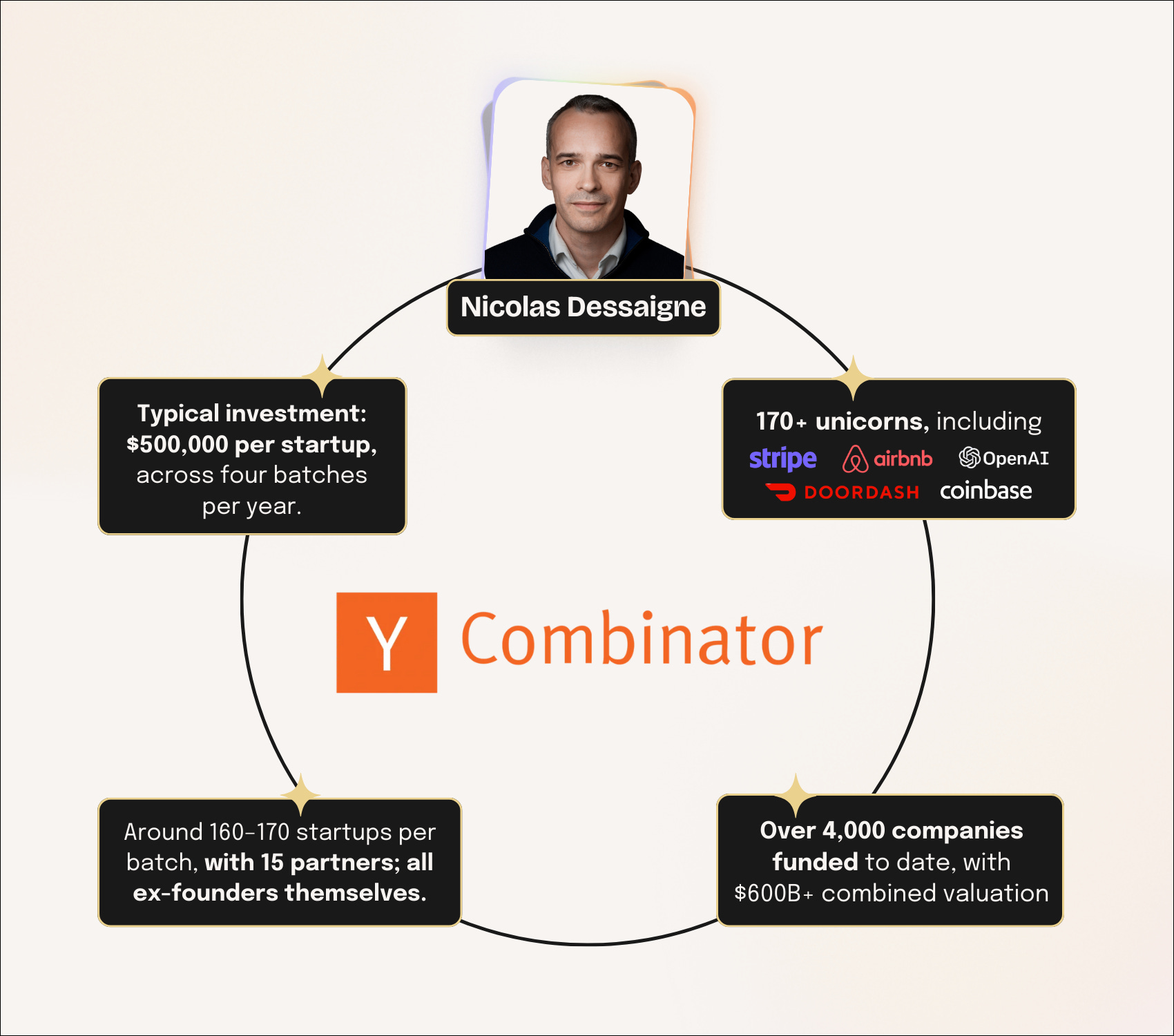
Over 4,000 companies funded to date, with $600B+ combined valuation.
170+ unicorns, including Airbnb, Stripe, Coinbase, DoorDash, and OpenAI.
Typical investment: $500,000 per startup, across four batches per year.
Around 160–170 startups per batch, with 15 partners — all ex-founders themselves.
Position & strategy:
YC is the world’s most influential startup accelerator, known for its intense three-month program that helps founders achieve product-market fit faster. Its edge lies in iteration speed, network effects, and founder-led guidance. YC continues to reinvent itself — recently expanding from two to four batches per year and rethinking what “product-building” means in the AI era.
Milestones:
2005: First YC batch in Cambridge, MA.
2010s: Alumni like Dropbox, Stripe, and Airbnb become global leaders.
2019: Launch of YC Continuity for late-stage funding.
2023: Shift from two to four batches per year, doubling the acceleration pace.
2025: YC embraces the AI-native generation, reshaping how founders build and iterate.
I sat down with Nicolas Dessaigne, Partner at Y Combinator, to discuss how YC builds products, and founders, for a world where code, iteration, and speed are being rewritten by AI.
Disclaimer: The organizational choices and technical solutions shared in this newsletter aren’t meant to be copied and pasted as-is. Always keep your company’s context in mind before adopting something that works elsewhere! 😊Backstory
When Nicolas joined YC as a partner, he brought the lens of a founder who had lived the journey (he co-founded Algolia and went through YC’s Winter 2014 batch).
A decade later, YC looks very different: it runs four batches a year, funds hundreds of startups at once, and has built a global alumni network of thousands.
But the core philosophy hasn’t changed.
“YC was never created as a copy of something. It was the first accelerator, built from first principles” — Nicolas explained.
Every batch is a live experiment. YC constantly adjusts its format, feedback loops, and resources to match how founders and markets evolve. Even major structural changes, like moving from two to four batches, were made in just a few months. “We decided in July and had the new batch start in September” Nicolas recalled.
What’s remarkable is how YC applies to itself the same principles it teaches founders: iterate fast, stay close to users (founders), and improve every batch.
All 15 YC partners are former YC founders, giving them a unique empathy for the startup journey, and a shared mission: “to make YC the YC we would have loved to have as founders.”
The new founder archetype
The YC founder profile has evolved. Nicolas observes that founders today are younger, faster, and more AI-native. The rise of large language models has dramatically lowered the barrier to building, making technical capability more accessible than ever.
“Everyone is using AI. It would be insane not to. It’s like asking, ‘Do you use the cloud?’” Nicolas said.
This shift has created a new archetype of founder:
Technical or product-first, but not necessarily a coder.
Highly iterative, leveraging AI to prototype, code, and test ideas daily.
Deeply ambitious, aware that the AI moment is now or never.
YC sees an influx of “high-agency” people, individuals who don’t wait for permission. AI tools like Replit, Cursor, and V0 let them build functional prototypes in days instead of months. The result: startups grow 10–12% weekly, a pace that was aspirational ten years ago.
How YC trains founders to build fast
Inside YC, speed is the universal currency.
Founders are pushed to shorten every feedback loop: talk to users, build, test, and repeat, not monthly, but daily.
Nicolas defines product excellence as “speed times quality.”
A product must be viable (“a crappy product that doesn’t provide value will go nowhere”) but perfection is the enemy of learning. YC encourages founders to find their balance: ship early, learn fast, and push just beyond their comfort zone.
“YC is not about dictating the balance between speed and quality. It’s on you to decide what’s critical. We’ll push you out of your comfort zone, and that’s where founders develop superpowers” Nicolas said.
That philosophy has made YC’s alumni unusually resilient. The post-batch slump, when momentum fades after Demo Day, remains the biggest threat. Founders who maintain their “YC speed” after graduation tend to win big.
When AI changes what a moat looks like
The most profound shift in the AI era isn’t about models, it’s about moats.
Nicolas argues that code is no longer defensible IP. With code generation tools producing 95% of early-stage code, differentiation comes from evaluation, how startups measure and refine model behavior.
“Code has become a commodity. Evals are more important” Nicolas said.
Evaluations, the internal tests that define what “good” looks like for an AI system, are now the secret weapon of leading startups. They encode expertise, context, and quality control that off-the-shelf models can’t replicate.
In YC’s lens, this changes everything: what technical founders focus on, how PMs think about value, and where AI-native companies build defensibility.
Why speed compounds: YC’s internal feedback loops
Just as startups learn through user feedback, YC learns through founder feedback. Every batch is a live system: what works is scaled; what doesn’t is replaced.
Half of Nicolas’s time is now spent helping alumni founders, a feedback mechanism that extends well beyond the 3-month program.
Events like Founder Mode, YC’s late-stage conference, keep the ecosystem learning collectively.
Nicolas describes YC as a “living accelerator”, its processes evolve as fast as its startups. The decision to add more batches, experiment with AI-native founder tools, and evolve selection criteria all stem from internal iteration.
In many ways, YC itself is a meta-startup, applying its own lessons of speed and feedback to remain relevant two decades later.

YC applies its own startup principles internally: iterate fast, learn faster, and evolve every batch.
The founder archetype has shifted from engineer to AI-native builder — execution speed trumps credentials.
Code is no longer a moat; Evals, data, and user feedback define defensibility.
YC’s strength lies in its continuous feedback flywheel — from batches to alumni.
Sustainable pace matters more than intensity; structured speed beats burnout.
Every startup’s success still comes down to two things: build fast and talk to users daily.
YC’s model proves that even the best institutions must evolve like startups themselves.
My full interview with Nicolas, Partner at Y Combinator
Dive deeper into this topic with Nicolas Dessaigne, Partner at Y Combinator, in my latest podcast episode:

Enjoyed this newsletter? Share it with your network using the button below—your support means a lot!
Curious how you think this model translates outside of pure software, especially in businesses where execution cycles are longer and constraints are more physical than digital.